Sept. 3, 2018 – “Bus Route 21: Spring Creek”
Written in 2018 and kept as originally published. Ages, figures and references to “recent” events reflect that time.
To the RMOW Mayor and Council:
Re: Transit efficiency, Improved Fire and Wildfire mitigation. (Spring Creek – Bayshores)
The following letter will introduce an idea that will not only improve transit efficiency, Fire Department response, and wildfire mitigation, but will also give Bayshores its own bus service and achieve this goal with no increase in operating costs.
This premise will focus on Bus Route 21: Spring Creek. Looking at Figure 1 below, the blue path of the bus is shown going south on Hwy 99, into Spring Creek, proceeding to the north end of Spring Creek where it turns around only to double back on the same track it from which it came. This route is, of course, subject to any traffic of Hwy 99 during peak periods.
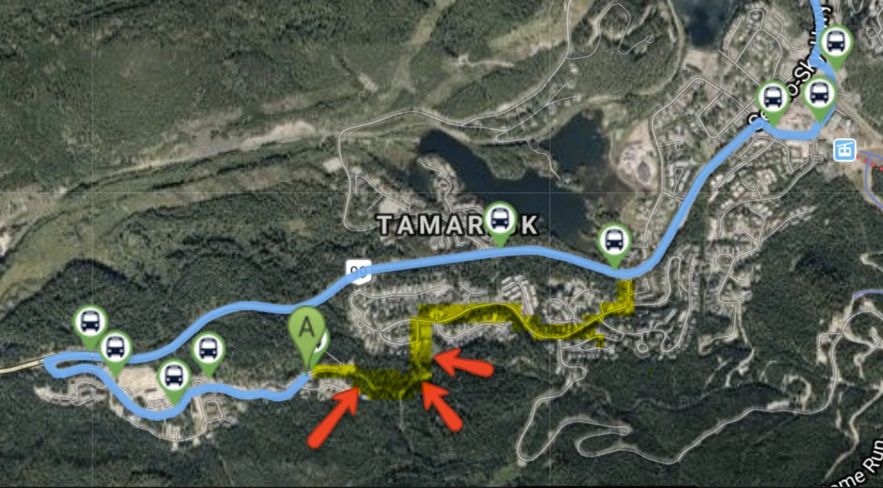
Figure 1
However, between the bus turnaround area at the north end of Spring Creek and the Millar’s Pond area of Bayshores, lies the Valley Trail, a distance of approximately 450 metres. This paved path is 10 feet wide and also acts as a service road to a water facility above Millar’s Pond. At present, the path can handle heavy vehicles, like plows, but can’t handle a Whistler transit bus nor any standard-sized fire trucks. If that trail was widened, it could easily become a one-way "bus and bike only access" restricted lane. To deal with traffic and commuter flow, it would be northbound in the morning and southbound in the afternoon.
The benefits to this proposal would be the following:
· Bayshores would now have bus service, as much as Spring Creek now enjoys.
· The elapsed time for Bus Route 21: Spring Creek would be vastly improved, especially during heavy traffic. This past Sunday afternoon, during moderate traffic, it took me seven minutes to travel from Spring Creek to Bayshores.
· The route distance would be shortened by 2 kilometres. With thirteen trips a day, that would be a 26 km reduction. That would be a saving of almost 9,490 km per year.
· A trail widened to handle a bus would also be able to handle any full-size fire apparatus, enhancing safety for both neighbourhoods and the response time for the Spring Creek fire hall. The volunteers could also use this route to quickly access the hall if needed.
· With a widened road, and a further clearing of trees and brush on either side of the path, the new clearing would now be an effective fire break. At present, the trail fails in this respect. Right now, a house fire in Millar's Pond could ignite the forests behind it, and there is nothing stopping it from climbing the mountain behind.
· At present, if there were some reason the road was closed between Alta Lake and Spring Creek—perhaps a serious accident involving a need for an RCMP accident investigation team—the valley would be closed off. This new lane would at least allow limited traffic, and bus service would remain effective! All that would be needed would be a few traffic control people at the north and south of the trail.
During peak traffic times, when Hwy 99 is bumper to bumper, the efficiency of this route would be so dramatic that this improvement would make it more desirable to ride the bus over driving your own car. At present, this is not the case. In order for transit to win, it must be better than driving on your own.
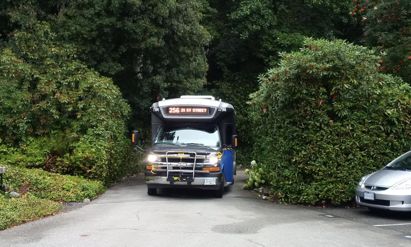
Figure 2
In Vancouver, Translink utilizes smaller community shuttle buses—24 instead of 53 passengers. (Figure 2) Rather than being 10-feet wide, these shuttle buses are only 7-feet wide, making it possible to use this current Valley Trail road with no improvements, and perhaps this would be a good option for transit to explore the effectiveness of this idea. Note: These smaller buses are also available in four-wheel drive.
Recently, council approved a plan to spend more on transit in order to make an express bus during peak hours; express buses still bring no comfort in gridlock, however. It may be prudent to have the new express bus use the same laneway as described herein, replacing the need for the Spring Creek buses during peak hours. It may even be possible that an express bus would not be required if the efficiency of every Route 21: Spring Creek bus was vastly improved during peak periods.
I stand open at anytime for questions regarding this proposal and happy to volunteer any time to this prospect.
Lance Bright
604-388-4545
Originally published September 23, 2018 on lancebright.com.