Written in 2018 and kept as originally published. Ages, figures and references to “recent” events reflect that time.
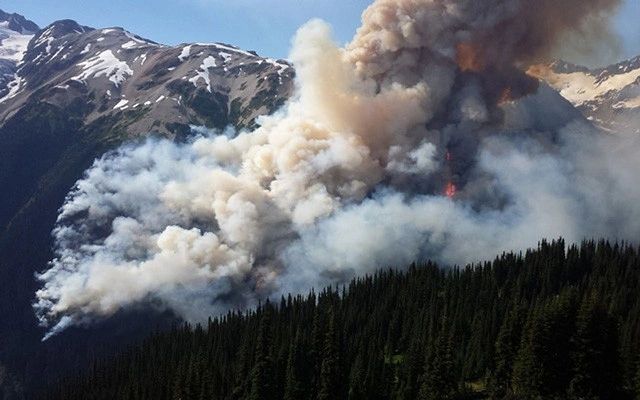
PHOTO COURTESY OF THE BC WILDFIRE SERVICE
Pique Newsletter – Letter to the Editor Link to Article
Wildfire is the greatest threat
Just as a sizable fire would affect the beauty we now enjoy, as business owners we must also consider the economic impact such an incident might have.
I came to Whistler as a newborn; my first home backed onto Whistler Mountain's Creekside, and our backyard was almost a clear cut.
Today, that area is overgrown with pine trees three to nine metres tall, all in such close proximity that their branches either touch or make contact with the ground. Any old-growth forest has trees two to three metres apart, not one metre like most young forests here. What is startling is that most neighbourhoods in Whistler back onto, or are surrounded by, similar dense-growth fire hazards—some within metres of valuable high-profile properties.
Consider the recent fire on Panorama Drive in Brio. The burning cabin, sitting on a steep grade with Whistler Mountain behind it, backed right onto one of these dense forests. It was contained by our fire department, but not without some help from Mother Nature as it was winter, with snow in the trees and on the wet forest floor. Still, a few trees behind the house ignited.
Now imagine if that same fire took place on a hot day in August instead of February. Flames would quickly climb the mountain behind it. Burning embers would be carried by the wind, and the trees, so close in proximity, would ignite not from contact but from the intensity of heat—all the firefighters and water bombers could in no way hold back nature's wrath in that case.
That is the fire I fear.
If Whistler were to have such a fire, word of our famous resort in flames would be "Breaking News."
Photos on social media would spread faster than the fire itself. And burning along with the reputation we fought so hard to build would be the tourist-industry income.
Considering the fires in B.C. and Alberta over the past few summers—and the massive dollar amount to contain them and then rebuild—we've been given ample warnings.
Doesn't making sure there is sufficient money for wildfire mitigation make fiscal sense?
A forest consultant from B.A. Blackwell & Associates was engaged by the Resort Municipality of Whistler (RMOW) and identified major areas of concern. The report included many recommendations and two options, both with 10-year goals in mind. The RMOW response was the least expensive option, $1 million a year plus grants, and treating only 25 per cent of the high-risk forest, leaving 75 per cent of high-risk forest areas as a constant threat to our community. It would take 40 years to achieve treatment of all high-risk areas, only to start all over again with new regrowth.
I am deeply disappointed with the response from all levels of government and our associated stakeholders.
There are times when mitigating a problem requires the appropriate amount of effort, otherwise "too little, too late" comes into effect.
If we burn, even partially, and it is world news, we will be spending millions to convince the world to come back to Whistler. Why don't we just spend some millions now and fix the problem?
If they think fire mitigation is expensive, try having a fire.
Lance Bright
Whistler
Originally published September 23, 2018 on lancebright.com.