July 26, 2018 – “It’s Our Problem Now, But Not Our Fault”
Written in 2018 and kept as originally published. Ages, figures and references to “recent” events reflect that time.
Pique Newsletter, Letter to the Editor – Link to article
IT'S OUR PROBLEM NOW, BUT NOT OUR FAULT
By Lance Bright
The Resort Municipality of Whistler (RMOW) council recently took on the massive job of firebreaks and thinning of 25 per cent of the high-risk, overgrown forests in our area.
This dangerous condition now present in our valley is actually rooted in the logging industry that occurred here from the late 1920s until the early 1970s. But it's what happened after that logging that has put us in danger.
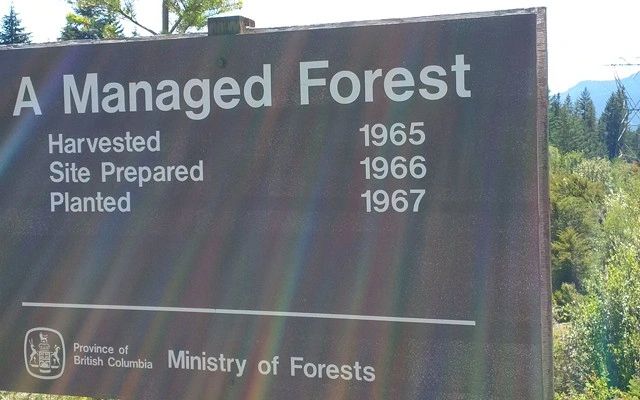
On the west side of Highway 99, just south of Function, there is a BC Ministry of Forests sign that reads: A Managed Forest / Harvested 1965 / Site prepared 1966 / Planted 1967.
As a child, I witnessed the replanting. Scores of tree planters came to town, mandated to plant every three steps, and many were paid per tree planted. They planted everywhere that had been logged.
Looking behind that sign now, you will see how that forest has grown. The trees are still three steps away from each other, and now they touch each other! Old-growth forests typically have trees two to three metres apart, not three steps apart. If you were to ski to the valley from Mid Station on Creekside, you can ski through the old growth, but once you hit where it was logged, the trees are so dense it is impossible to pass.
Without a thinning in over 50 years, this is now a major fire hazard.
As an elementary student at Myrtle Philip Community School, I was impressed that foresters from the ministry came and briefed us on the reforestation process. My sarcasm was in its budding stage then, and I do recall saying to them that they need to change their sign to "Ministry of Forests, Trees, Bushes, Shrubs and Stumps" to reflect Whistler.
They gave us seedlings to plant, and warned us that most would die—they underestimated on that. (I planted 10. One was just recently cut down, and one still stands. The rest were ripped out by my dog.) They explained that thinning would be needed in the future to accelerate the forests' growth to maturity and reduce fire hazards. They would cull the weaker trees so the stronger ones would have more room to grow, while making the forest less flammable. They explained that trees fighting one another was not the ideal, and some would win and the losers would die a slow death and become a fire hazard.
That is what I see today.
Forgotten somewhere in time, though, that planned thinning never occurred—at least not until recently, and only by the RMOW—a token amount with respect to the entire problem.
What happened?
Perhaps it was the economic crash of the early 1980s, with interest rates of 20 per cent and massive spending cuts, so that thinning was deferred to another residing government.
Cutting costs, not trees, was the focus of governments through the 1980s and 1990s. And there was a time when cutting any tree was not politically correct.
So does this excuse the duty of care on the part of province? Does transferring this land to the RMOW absolve obligations. When the trees were logged, the B.C. government charged stumpage fees to the logging companies and collected taxes. Since then, the government has not maintained what they replanted, and in 1975, we inherited this problem, as those forests went from B.C. government control to RMOW.
A town of about 10,000 should not have to bear the costs alone, nearly $60 million in today's dollars.
All Whistler and area stakeholders need to be engaged, and I believe the next council must be more assertive with the province on this issue. (When Victoria learns how much they can lose, I am sure they will chip in.)
Once that fire starts, that $1.5 million per day tax revenue that flows down the road from Whistler to government will immediately stop, do a 180-degree turn (maybe even right in front of their "Managed Forest" sign) and have to start flowing the other way, as in addition to all the hard costs of fighting the fire, Alberta paid Fort McMurray $107.25 million to rebuild.
I guess all those foresters that came to Myrtle Philip school have since retired.
Lance Bright
Whistler
Originally published September 16, 2018 on lancebright.com.